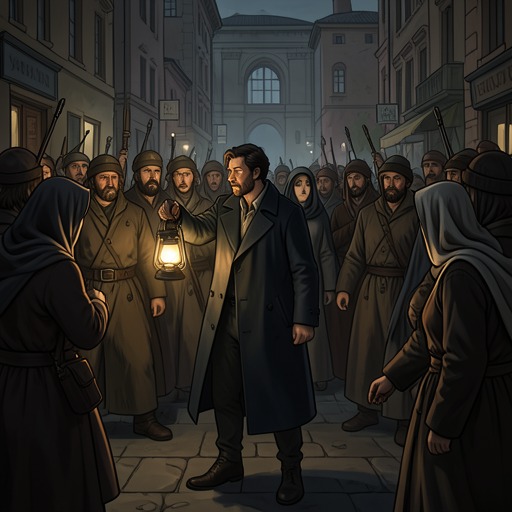
Guido degli Anastagi
The DecameronGuido degli Anastagi is a knight whose suicide and unrelenting pursuit of the woman who rejected him have become a supernatural spectacle of punishment. In the pine wood, he tells Nastagio degli Onesti that their shared history has been transformed by divine justice: once a desperate lover, he is now condemned to hunt his former beloved as an enemy, kill her, and see her rise again to suffer the same fate. Guido’s story makes private despair into a public warning—and gives Nastagio a means to influence the woman who has rejected him.
Identity and Background
Guido identifies himself as a knight who came from the same city as Nastagio. When Nastagio was still a little child, Guido was passionately in love with the woman he now pursues. He attributes his despair to her hard-heartedness and cruelty. At the end of that despair, he used the tuck he still carries to kill himself.
The woman died not long afterward. Guido says she rejoiced at his death and did not repent of her cruelty or consider it sinful. In his account, their deaths did not end their relationship; instead, they brought both into an afterlife in which their former attachment was recast as hostility and punishment. Guido’s explanation is the only account of his past supplied in the scene, and it presents his fate through his own explanation of divine justice.
Sentence and Repeated Hunt
Guido describes a sentence imposed on both of them: the woman must flee before him, while he must pursue her not as a beloved but as a mortal enemy. Whenever he catches her, he is to kill her with the same tuck he used to kill himself, open her body, tear out the heart that would admit neither love nor pity, and give it to the dogs. This enactment joins the cause of Guido’s despair to the form of his punishment: the heart associated with her refusal becomes the object of an endlessly repeated violence.
The punishment is not confined to a single place or moment. Every Friday, at the same hour, Guido catches the woman in the pine wood, where Nastagio happens upon them. On other days he overtakes her elsewhere, in places where, according to Guido, she had thought and acted cruelly toward him. The hunt is therefore both regular and ongoing: its Friday recurrence makes it available to witnesses, while its continuation elsewhere makes clear that the spectacle is only one part of their sentence.
Guido also describes its duration as proportionate to the woman’s cruelty. He must pursue her for as many years as she had been cruel to him for months. The account turns time into a measure of retribution, extending the remembered imbalance between the lovers into an afterlife penalty. Guido presents himself as the agent who carries out the sentence, but its terms, as he explains them, are fixed by God’s justice and power.
The Scene in the Pine Wood
When Nastagio approaches, he sees the woman fleeing naked through brush and brambles, pursued by two Mastiffs and Guido on a black horse. Guido wears dark armour and carries the weapon with which he killed himself. Nastagio, moved by compassion, takes a tree branch as a club and advances to defend her, despite having no arms. Guido warns him not to interfere and explains who he is and why the pursuit must continue.
After the dogs seize the woman and bring her to a halt, Guido dismounts. Nastagio protests that it is a great felony for an armed knight to attack a naked woman and set dogs on her as though she were a wild beast. He declares that he will defend her as best he can. Guido answers his appeal not with a change of course but with the account of their deaths and sentence. Nastagio, terrified by the explanation, withdraws and watches.
Guido then runs at the woman with the tuck, strikes her through the breast, and, after she falls, opens her body and casts her heart and surrounding entrails to the Mastiffs. They devour them. Soon afterward, the woman rises as though nothing had happened and flees toward the sea with the dogs still tearing at her; Guido and the pursuit disappear from Nastagio’s sight. The visible sequence turns Guido’s account into action, confirming for Nastagio that the violence is repeated rather than final.
Role in Nastagio’s Plan
Nastagio recognizes that the recurring Friday scene might serve his purpose. He asks his relatives and friends to invite the woman he loves, along with her family and other ladies, to a banquet in the pine wood on the next Friday. He arranges for his beloved to sit opposite the place where the pursuit is to occur. Guido’s routine thus becomes the centrepiece of a deliberately staged encounter: the scene that first appeared as an interruption to Nastagio’s melancholy is made into a spectacle for the woman whose rejection has distressed him.
When the cries begin during the meal, the guests rise and witness Guido pursue and kill the woman again. Some rush forward to help, but Guido addresses them as he had addressed Nastagio, and his explanation fills them with terror. Among the guests are women who had known the hunted woman and Guido, and who remember his love and death; they weep as though the violence had been done to them. Guido’s history, formerly a private tragedy, is now witnessed and interpreted by a company that includes people connected to its past.
The spectacle frightens Nastagio’s beloved because she understands it as relevant to her own conduct toward him. That evening, she sends a trusted chamberwoman to ask Nastagio to come to her and to say that she is ready to do his pleasure. Guido does not appear as an ordinary participant in their courtship, but his repeated punishment supplies the threat that changes its course. The ending gives his scene a double force: it demonstrates the severity of the sentence Guido describes, and it enables Nastagio to turn another woman’s suffering into leverage over his own beloved.
Narrative Significance
Guido is both a speaking witness to his past and the executioner within the recurring scene. His explanation connects the lovers’ deaths to the spectacle Nastagio sees, while his actions embody the sentence in a series of unmistakable gestures: pursuit, the blow, the opened body, the heart given to the dogs, and the woman’s renewed flight. The return to the same violence prevents death from closing the story; instead, it becomes a repeated event that can be seen and used by the living.
The story frames the hunt as divine justice, yet its effect in the plot is also practical and unsettling. Guido’s punishment terrifies an audience, and Nastagio exploits that terror to obtain a response from the woman he loves. The force that makes Guido’s sentence memorable is thus inseparable from its use as a warning. His past remains bound to the woman who rejected him, but in Nastagio’s hands their afterlife ordeal becomes a means of shaping a different relationship among the living.